Deskjet 2855E 2852E First Look: Unboxing and Impressions
Introduction
The Deskjet 2855E and 2852E arrive positioned as budget-friendly, entry-level all-in-one inkjet printers intended for home and small-home-office use. They aim to balance a compact footprint with the core functionality many buyers need today: printing, copying and scanning, wireless connectivity, and straightforward mobile workflows. This first-look review walks through the unboxing experience, initial setup, everyday performance impressions, and practical considerations for potential buyers. It is written in an editorial, third-person tone focused on what matters in real-world use—reliability, operating cost, output quality, and convenience.
Unboxing and First Impressions
Out of the box, both the Deskjet 2855E and 2852E present as compact, plastic-bodied units with a modest footprint suitable for a desk, shelf, or small credenza. Packaging is minimal and utilitarian, with accessories and documentation neatly arranged to reduce waste and speed unboxing. Included in the box are the printer itself, a power cable, basic setup documentation, and starter ink cartridges. The exact contents may vary by region and retail bundle, but the expectation for buyers should be that this is a no-frills package designed for quick setup rather than an extensive accessory kit.
Physically, the design philosophy is unobtrusive. These models do not attempt to look premium; instead, they emphasize practicality. Buttons are limited to a few physical controls for power, cancel, and wireless status, while most advanced setup and scanning functions are handled through a companion mobile app. For buyers prioritizing a small, functional machine rather than a statement piece, the initial visual and tactile impression is positive: light, compact, and straightforward.
Product Overview and Key Features
At their core, the Deskjet 2855E and 2852E are intended for light to moderate document printing, occasional color jobs, and basic scanning/copying. Key feature areas to note:
- All-in-One Functionality: Print, scan and copy in a single chassis—convenient for handling homework, household records, and simple photo tasks.
- Wireless Connectivity: Wi‑Fi support enables printing from laptops, phones, and tablets. Mobile printing via a companion app is a central part of the workflow.
- Compact Footprint: Designed to fit small workspaces where a full-size office printer would be too large.
- Starter Ink Set: Ships with starter cartridges; users with regular print volumes will want to plan for replacement cartridges or a subscription service to manage running costs.
Design and Build
Both models prioritize compactness over heavy-duty build. The chassis uses matte and semi-gloss plastics with simple lines. The input tray blends into the rear or top depending on configuration, and the output area is just large enough for everyday pages. The scanner platen lies under a hinged lid; the lid itself is thin, so users should not expect heavy-duty pressure for thick materials, but it handles standard documents and occasional card stock without issue.
Controls are intentionally minimal. Most operations—such as scanning to a phone or adjusting print settings—are routed through the mobile app or the host computer. For users who prefer physical control panels with displays and multiple buttons, these Deskjet models may feel sparse. However, the minimal control layout keeps the front panel clean and reduces accidental presses.
Setup and Software
Setup follows the increasingly common approach: plug in, power on, connect to Wi‑Fi, and complete the rest through the companion app. The app guides users through cartridge installation, alignment, and registering the printer on the network. This app-centric setup works well for users comfortable with smartphones, and it makes scanning to a phone or cloud service simple.
For those who prefer to use a laptop, standard drivers and a basic utility are usually available from the manufacturer’s website. Buyers should verify compatibility with their operating system, especially if they run less common Linux distributions or older macOS versions—driver availability varies by region and SKU.
Find top-rated Electronics products at great prices.
View Offers →Printing Performance
In everyday use, these Deskjet models behave like typical low-cost inkjets. Black text prints are generally clean and legible, suitable for letters, school assignments, recipes, forms, and other document-driven tasks. Color prints are acceptable for casual use—handouts, charts, and occasional snapshots—but users seeking high-fidelity photo reproduction should not expect professional-level color accuracy or saturation.
Warm-up and first-page times are quick for occasional tasks, and the printer handles short print runs without intervention. The machines are not built for sustained heavy throughput; extended print jobs (dozens of pages in a single session) will likely trigger pauses or warm-downs to avoid overheating, and ink consumption increases with frequent color output. For households or small teams printing only a few pages daily, performance is practical and predictable.
Scanning and Copying
The flatbed scanner is straightforward for digitizing receipts, homework, and document pages. Scanning quality is typical for this class—adequate for OCRing printed text and archiving, with color scans that capture enough detail for personal records. Scanning speed and software features depend heavily on the app or PC software: direct-to-cloud, email, or local save options vary by region and app version.
Copying is basic and reliable for single- or multi-page small jobs. For more advanced copying features—automatic document feeders (ADF) or duplex scanning—buyers should look at higher-tier models, as these Deskjests generally do not include an ADF.
Connectivity and Mobile Features
Wireless networking is the primary connection method, enabling printing from smartphones and laptops without cables. The companion mobile app simplifies mobile workflows: printing images or PDFs from a phone, scanning directly to a mobile device, and occasional firmware updates. AirPrint and Mopria compatibility are often supported on similar models, so users with Apple or Android devices will likely find native mobile printing options available.
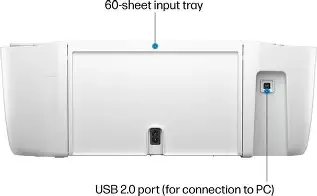
Wired USB may be present for direct connection to a single computer; however, networking and app-based workflows are emphasized. Users who need a permanent wired network connection (Ethernet) should verify the specific SKU, as budget home printers commonly omit Ethernet ports.
Running Costs and Ink
Running cost is the critical long-term consideration with inexpensive inkjets. Starter cartridges included in the box are intended to get the unit operational; they rarely deliver the page yields of full-size replacement cartridges. Replacement cartridges compatible with these models are widely available, and higher-yield (XL) options help lower cost per page.
Many buyers now consider ink subscription services offered by major manufacturers because subscriptions can reduce surprises in ink costs and include home delivery. Whether that is a worthwhile option depends on the user’s print volume and desire for convenience. Users with very light volume may find subscription unnecessary, while frequent color printers may benefit from the predictability.
Discover deals on Electronics — updated daily.
Browse Now →Pros & Cons
- Pros:
- Compact, space-conscious design that fits small desks and apartments.
- Simple unboxing and app-guided setup make it accessible for non-technical users.
- All-in-one functionality (print/scan/copy) covers the essentials for most households.
- Wireless printing and mobile app integration support modern workflows like printing from phones and scanning to cloud services.
- Affordable entry price point for budget-minded buyers.
- Cons:
- Not intended for heavy or continuous printing—limited duty cycle compared to office-grade devices.
- Running costs can be high without using XL cartridges or a subscription service.
- Limited control panel and lack of advanced features such as automatic duplexing or an automatic document feeder on most SKUs.
- Build materials are lightweight; the unit is not designed for heavy physical stress or industrial environments.
Comparison: Deskjet 2855E vs Deskjet 2852E
Both models belong to the same product family and share the core mechanical platform. The differences are primarily in regional SKUs and possible bundled accessories or preinstalled ink configurations. The following table highlights the practical points prospective buyers might compare.
| Specification | Deskjet 2855E | Deskjet 2852E |
|---|---|---|
| Form factor | Compact all-in-one inkjet | Compact all-in-one inkjet |
| Functions | Print, scan, copy | Print, scan, copy |
| Connectivity | Wi‑Fi, USB (varies by region) | Wi‑Fi, USB (varies by region) |
| Recommended use | Home, students, light home office | Home, students, light home office |
| Input tray capacity | Approx. 60 sheets (typical for this class) | Approx. 60 sheets (typical for this class) |
| Automatic duplexing | Generally not included | Generally not included |
| Cartridge compatibility | Standard replacement cartridges (region-specific part numbers) | Standard replacement cartridges (region-specific part numbers) |
| Key difference | Minor SKU and bundle differences by region; check included starter ink | Minor SKU and bundle differences by region; check included starter ink |
Buying Guide
Choosing the right low-cost all-in-one printer is less about headline specs and more about matching a machine to the buyer’s real use. The Deskjet 2855E and 2852E are well-suited to particular user profiles; the following buying guide helps potential purchasers decide whether one of these models is the right fit.
Who should consider these printers?
- Households that print sporadically—recipes, school worksheets, or occasional correspondence.
- Students who need a compact, inexpensive printer for assignments and small projects.
- Remote workers who require a simple device for printing invoices, forms or one-off documents and who place a premium on a small footprint.
- Anyone looking for an inexpensive scanner for receipts, bills and quick archives without needing an ADF or professional scanning features.
Who should look elsewhere?
- Small teams with high monthly page volumes—look for higher-duty-cycle, business-class models with larger paper handling and faster speeds.
- Users requiring advanced scanning (ADF or duplex scanning) or heavy photo printing—consider mid-range models or models with dedicated photo printing capabilities.
- Buyers who want the absolute lowest ongoing cost per page—laser printers can be more economical for high black-only volumes.
What to check before buying
- Cartridge cost and availability: Verify the exact cartridge part numbers for the region and compare the cost of standard vs XL cartridges.
- Subscription options: Investigate whether an ink subscription is available and whether it reduces total cost of ownership for the expected monthly volume.
- Operating system support: Confirm drivers and app support for the buyer’s devices, especially if using Linux or older macOS builds.
- Connectivity needs: If a wired network connection is required, confirm whether the specific SKU includes Ethernet; most budget models do not.
- Print volume expectations: Match the monthly page volume to a printer’s recommended capacity—these Deskjets perform best under light-to-moderate loads.
Alternatives to consider
For those whose needs fall outside the light-use profile, consider these alternatives:
- For heavier black-and-white volumes, a monochrome laser is often more economical and faster for text.
- For frequent duplexing and multi-page scanning, look at small office multifunction printers with automatic document feeders.
- For better photo output, a dedicated photo inkjet or an inkjet with a broader color gamut and higher resolution will deliver superior results.
Real-World Use Cases
To ground the overview in practical scenarios, here are several representative use cases and how the Deskjet 2855E/2852E perform in each:
- Student assignments: Fast setup and reliable text output make these printers a solid option for students needing to print essays, problem sets, and lab reports. Occasional color graphics print acceptably for class handouts.
- Home office paperwork: Favorable for low-volume invoice printing, correspondence, and form filling. Scanning receipts or signed documents to email or cloud storage is easy via the mobile app.
- Family photo snapshots: Handy for home-printed snapshots and casual photo projects, but not intended for poster-sized or high-color-accuracy prints.
- Receipts and records digitization: The flatbed scanner is convenient for occasional digitization work; however, for frequent multi-page scanning, an ADF-equipped device is preferable.
Conclusion
The Deskjet 2855E and 2852E represent sensible options for buyers seeking an inexpensive, compact all-in-one that covers the basics of home printing, scanning and copying. They excel where many buyers need them to: space efficiency, simple setup, and solid document printing for low to moderate daily volumes. They are not designed for heavy duty office use or professional photo production, and the real cost of ownership depends heavily on cartridge choice and print volume.
For households, students, and remote workers who need a dependable, easy-to-use device without advanced features, these Deskjets are practical choices. Prospective buyers should evaluate expected monthly print volume, cartridge costs, and whether features such as automatic duplexing or an ADF are necessary before deciding. In the right environment, these models provide a straightforward, economical printing experience that meets everyday needs without unnecessary complexity.