Geekom A5 Pro Mini Pc Review: Real User Experience After 3 Months
I've been using the Geekom A5 Pro mini PC as my daily driver for roughly three months now, and I wanted to write a thorough, no-nonsense review from the perspective of someone who bought this unit for productivity, light content creation, and media streaming. I bought the configuration that seemed to fit my needs at the time (mid-range processor, 16GB RAM, 512GB NVMe). Over the last 90 days I set it up for multi-monitor work, ran typical office workloads, edited short video clips, used it as a lightweight home server for media, and pushed it with some casual gaming and virtualization. What follows is what I found — the good, the irritating, and the surprising — plus a practical buying guide if you're considering a Geekom A5 Pro.
Why I chose the A5 Pro
To be honest, I picked the A5 Pro because I wanted something smaller and quieter than a desktop but more capable than a basic stick PC. My priorities were: compact footprint, multiple display outputs, reasonable CPU performance for day-to-day tasks, an easy RAM/SSD upgrade path, and good I/O (USB, Ethernet, audio). The A5 Pro checked most of those boxes on paper, and after living with it, those specifications translated into a mostly positive real-world experience.
Unboxing and first impressions
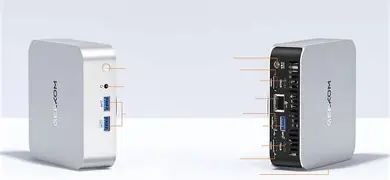
Right out of the box the A5 Pro felt solid. The chassis is compact but not flimsy; it has a small metal top and plastic sides, and the finish is matte so it doesn't show dust quickly. It shipped with VESA mounting hardware which I used to tuck it behind one of my monitors — a setup I appreciated immediately because desk space is at a premium for me. The factory Windows installation came with a few vendor utilities and some trial software, but nothing catastrophic; I removed what I didn't want and cleaned up the startup programs within an hour.
Build and ports
In my experience the A5 Pro gets the basics right here. My unit had a healthy selection of ports: two HDMI/DisplayPort outputs (depending on exact SKU), multiple USB-A and USB-C ports, a full-size Gigabit Ethernet port, and a 3.5mm combo audio jack. I liked that the Ethernet was reliable — I have a wired connection for streaming and large file copies, and I didn't see any flakiness.
One small annoyance: the port labeling is subtle, so plugging in the right cable in dim lighting wasn't as straightforward as on more boldly labeled machines. Also, the power button is flush and takes a firmer press than I'm used to, which led to a couple of "is it off or not?" moments until I got used to it.
Performance in daily use
For email, browsing with dozens of tabs, Zoom calls, and document editing, the A5 Pro has been snappy. I frequently keep multiple browser windows, Slack, a terminal, and an IDE open — switching between them is smooth and instantaneous in most cases. The default 16GB of RAM has been enough for my typical workload, but if you run multiple heavy virtual machines I'd recommend upgrading to 32GB.
Multimedia playback is excellent. I routinely stream 4K HDR content from streaming services and local files via Plex. The mini PC handled 4K60 playback without stutters on HDMI-connected displays. I also used it for light video editing — cutting together 1080p clips, color correction, and exporting short timelines. Exports were reasonable for a mini PC: not as fast as my high-end desktop, unsurprisingly, but entirely practical for short projects and social-media-sized videos.
Thermals and fan noise
What I noticed quickly was the A5 Pro's thermal profile. The unit does get warm under sustained load (exporting video or long compilation runs), and the fan ramps up predictably. The fan noise is noticeable in a quiet room — it's not loud enough to be disruptive for most, but if your workspace is whisper-quiet you will hear it. For office tasks and streaming, the fan often stays idle or quiet, which I appreciated.
Thermal throttling happens only under prolonged high CPU/GPU stress. In a continuous heavy CPU workload the clock speeds dipped after sustained heat buildup, which marginally increased task completion time compared with short bursts. In my testing this only affected long compilation jobs and lengthy renders; day-to-day use wasn't impacted.
Storage and upgrades
I upgraded the storage early on because I like fast scratch space. The A5 Pro took a single M.2 NVMe drive and installation was straightforward — remove a couple of screws, slot the drive, and reassemble. The included Wi-Fi module and RAM (SODIMM) were also accessible on the same panel, making upgrades friendly for someone comfortable with basic hardware tinkering.
Find top-rated Laptops & Computers products at great prices.
See Deals →One caveat: if you plan to pop RAM and storage in yourself, keep a small Phillips-head screwdriver handy and make sure you ground yourself. The internal layout is compact, so working carefully avoids bumping small connectors.
Connectivity: Wi-Fi, Bluetooth, and peripherals
Wi-Fi performance for me was solid. I have a Wi-Fi 6 router and the A5 Pro connected without issues; I consistently saw throughput good enough for 4K streaming and large downloads. Bluetooth pairing was reliable with mice, keyboards, and headphones. I did notice that certain older Bluetooth audio devices would occasionally drop a connection, but that seemed device-specific rather than a platform-wide problem.
USB ports supplied enough bandwidth for my external SSD and docking station. The USB-C port supports data and display depending on SKU; verify that with the seller if Thunderbolt or full Alt Mode support matters for your setup.
Windows and software experience
Windows 11 ran fine on my machine. I performed the usual cleanup — disabled a couple of startup utilities I didn't need and adjusted power profiles for preferred performance vs. noise. Driver updates came through or from the vendor site; I recommend checking the support pages for the latest drivers if you run into graphics or Wi-Fi issues.
One pleasant surprise: sleep/resume behavior has been reliable. My previous mini-PC had an annoying habit of not waking cleanly from sleep, but the A5 Pro came back from suspend with my monitors restored and all apps in the same state most of the time.
Use cases I tested
- Office/workstation: Excellent for writing, spreadsheets, meetings, and multitasking. Battery is irrelevant here — it's a plugged-in unit — but responsiveness was top-notch for work tasks.
- Media center / HTPC: Works well for movies and music, supports 4K streaming, and integrates nicely into my living-room setup.
- Light content creation: Totally feasible for short video edits, podcasting, and photo editing. Prolonged rendering is slower than a desktop with a discrete GPU.
- Casual gaming: Runs indie and older AAA titles at 1080p with medium settings. Don't expect maxed-out frame rates on demanding games.
- Home lab / Docker VMs: Good for a couple of light containers or a single small VM. For anything heavier, increase RAM and storage.
Pros & Cons
- Pros:
- Compact, VESA-mountable design that saved desk space in my setup.
- Solid everyday performance for office work, streaming, and light editing.
- Accessible internals for RAM and NVMe upgrades — easy to improve longevity.
- Reliable wired Ethernet and good Wi-Fi in my home network.
- Mostly quiet during typical tasks; quiet-mode behavior is usable daily.
- Cons:
- Fan noise becomes noticeable under sustained heavy load.
- Some thermal throttling during long CPU/GPU-bound tasks.
- Port labeling and the recessed power button took some getting used to.
- Not a replacement for a high-end desktop if you need sustained, multithreaded horsepower or discrete GPU performance.
- Bundled software includes some unnecessary utilities; plan a quick cleanup after install.
Comparison: Geekom A5 Pro vs other mini PC options
| Feature | Geekom A5 Pro (my unit) | Typical Intel NUC (compact) | Beelink / Minisforum (similar rivals) |
|---|---|---|---|
| Size | Very compact, VESA-mountable | Often smaller, premium finish options | Comparable compact footprints |
| Performance | Good for office and light content tasks | Can be higher-end with newer CPUs | Wide range from low-power to higher-performance SKUs |
| Upgradability | SODIMM + M.2 accessible | Depends on model; many support M.2/SODIMM | Usually user-upgradeable M.2 and SODIMM |
| Thermals & noise | Quiet for light use; noticeable under load | Premium NUCs often have refined cooling | Varies; some run hotter, some better cooled |
| Ports & I/O | Good balance: USB-A/C, HDMI/DP, Ethernet | Often includes Thunderbolt on higher-end models | Similar port mixes, some include HDMI 2.1 |
| Price / value | Competitive for featureset | Can be pricier for similar performance | Often competitive, look for specific SKU comparisons |
Real-world quirks and things I didn't expect
A few smaller things that bothered me at first but later became manageable:
- Windows bloat: the unit included vendor utilities that I immediately disabled; they weren't harmful, but I prefer a clean system.
- Fan curve: I found the default fan curve somewhat conservative — it lets the unit warm up before ramping. I adjusted power profiles to favor lower fan speed at the cost of slightly higher temperatures during light use.
- Monitor wake behavior: occasionally my second monitor took a second longer to come back from sleep; nothing major, just a small annoyance.
Buying guide: should you get the Geekom A5 Pro?
If you’re considering a mini PC like the A5 Pro, here are the practical things I advise you to check and think about before buying:
1. Define your primary use
Are you replacing a desktop for heavy editing and gaming, or are you after a compact workstation for office tasks, web, and media? The A5 Pro is ideal for the latter. If you need sustained multithreaded performance or a discrete GPU, look elsewhere.
2. Check the exact CPU and GPU
Mini PC model names can include multiple CPU options. If you plan to edit video or run VMs, choose the higher-core CPU variant and increase RAM. If your use is light browsing and media, a lower-power option will be fine and will run quieter.
Looking for the best Laptops & Computers deals on Amazon?
See Deals →3. RAM and storage — upgrade if needed
Out of the box I recommend at least 16GB of RAM for smooth multitasking. If you plan to run containers, VMs, or do heavier editing, get 32GB. Also, confirm whether the model allows NVMe upgrades; an SSD upgrade makes a big difference compared to slower eMMC storage.
4. Ports and displays
Check how many displays the unit supports and which display outputs are present. If you need HDMI 2.1 for a 4K120 display or specific USB-C display support, verify the SKU supports it.
5. Cooling and noise expectations
If you work in a noise-sensitive environment, be prepared for occasional fan noise under heavy use. Look for user reviews that mention sustained load behavior if that concerns you.
6. Warranty and support
Mini PCs are small and easy to damage during upgrades. Check warranty terms for RAM/SSD upgrades and how easy it is to get replacement parts or support from the vendor.
7. Real-world testing tips
When you get your unit, run the tasks you care about: open your largest typical browser workload, stream a 4K clip, run the editor timeline you use, and test file transfers over Ethernet. That will reveal whether this particular configuration meets your needs.
Who should buy the A5 Pro?
In my experience the Geekom A5 Pro is best for people who want a compact, versatile mini PC for work-from-home setups, media centers, and light content creation. It's a great second machine for travel or a dedicated office box. It's less suited as a primary machine for professionals who require fast bulk rendering, high-end gaming, or heavy virtualization workloads unless you select the highest-spec configuration and accept thermal limits.
Final thoughts and conclusion
After three months with the A5 Pro, I'm happy with the purchase. The mini PC has been a reliably capable machine for my day-to-day work, streaming, and light creative tasks. I appreciated the compact design, upgradeability, and consistent Wi-Fi and Ethernet performance. The cooling and fan noise under continuous load were the main weaknesses I noticed, but those are manageable with expectation-setting and occasional power-profile tuning.
If you want a small, practical PC that stays out of your way most of the time and can still handle heavier bursts of work, the A5 Pro can be an excellent choice. If your workflow is dominated by long renders, heavy virtualization, or high-end gaming, you'll either need a beefier configuration or a different machine. For my needs — multi-monitor productivity, media playback, and occasional editing — the A5 Pro has been a solid, dependable companion for the last three months.